How to find the perfect SaaS idea
If you found this post, there’s a good chance you’re interested in starting a SaaS company. Maybe you’re a developer who wants to build their own software product instead of working for other companies.
Or you’re attracted to the sweet recurring revenue business model and high-profit margins.
And maybe you dream of having a life-changing exit.
It’s great to dream. However, starting a SaaS business is a lot of work. It’s probably going to take A LOT longer to make money than you think, require at least a couple of pivots to reach product-market fit, and consume several years of your life. You’ll also need to navigate uncertainty and market dynamics.
All that is to say: you want to make sure you’re starting a SaaS for the right reason. And that you’re starting with an idea that has real potential to be a viable product in your target market.
In this post, we’ll share three actionable strategies you can use to come up with product ideas, validate them, and make sure they’re actually worth building — not just for your market, but for you.
Part 1: Market Research
The first part of finding great startup ideas is to start searching for problems. Here are some strategies you can use:
Ask your audience about problems they are encountering.
Turn to Google and search for negative language like, “X sucks,” “I hate X,” or “Why is X . . .”
Repeat the same negative language searches on Reddit, Twitter, Facebook, LinkedIn, or other social media channels.
No problem or idea is too dumb at this stage. Often, the dumbest ideas can lead to some of the best ones!
Once you have around 5 promising problems, it’s time to research each problem deeper. One of the best ways to do this is by creating content around each problem: how to identify the problem, ways to solve it, pros and cons of those solutions, etc.
This content could include everything from “ultimate guide” blog posts to podcast episodes and YouTube videos.
As you publish and distribute your content, make a note of any feedback (or lack thereof!).
The problem you select should be the one that’s the most painful, least complex for you to solve, and has the highest value for potential customers.
Part 2: Market Validation
Once you have a promising SaaS idea, it can be tempting to start building an MVP. Resist the urge to start building! Instead, focus on validating your idea. This will save you a lot of time and pain down the road.
In fact, The Iron Law of the Market states:
“Even the most ingenious idea will fail if no one wants it - creating something no one wants is a waste.”
The best way to validate a market is to TALK TO A LOT of your ideal prospects.
Start by leveraging the content you’ve already created to get feedback, seek out additional questions, and find more opportunities to get in front of your ideal prospects.
Pro tip: An underrated way to get in front of a lot of people is by speaking at meetups and conferences. You’ll learn a lot in a short period of time (a few days), get rapid feedback, and the Q&A after your talk tends to be amazing market research.
Once you have a list of your ideal prospects from content and/or events, you’re going to want to branch out from 1:many conversations to 1:1 emails and calls. That’s where you’ll learn the most and get valuable feedback around your idea.
Here are some tips to make these calls go smoother:
Be personal - Treat these calls as a conversation, not an interrogation.
Get specific - Ask for details, and clarify any confusion.
Ask the “magic wand question” - “If you could wave a magic wand, what would you fix or do differently?”
Record the calls.
Stay in touch and follow up!
Pro tip: Looking for additional tips on how to structure prospect and customer interviews? Check out these Startups for the Rest of Us episodes:
As you receive feedback and new insights from these calls, make sure you’re using it to refine your idea. The more calls you take, the more clarity you’ll have around your idea, the problem you are solving, and who your ideal customers are.
An excellent way to road-test your product is by pre-selling it. This dramatically reduces the risk that you’ll end up building a solution no one wants.
Once you have enough confidence in your SaaS idea, make an offer and ask for the sale. If at least 5 of the people who you talked to in these interviews end up buying it, that’s a strong signal that you’re on the right track.

This is exactly what Pawel Brzeminiski did when validating his SaaS idea. Over the course of 10 weeks, he sent 174 emails, which led to 32 people agreeing to calls. And 7 pre-sales.
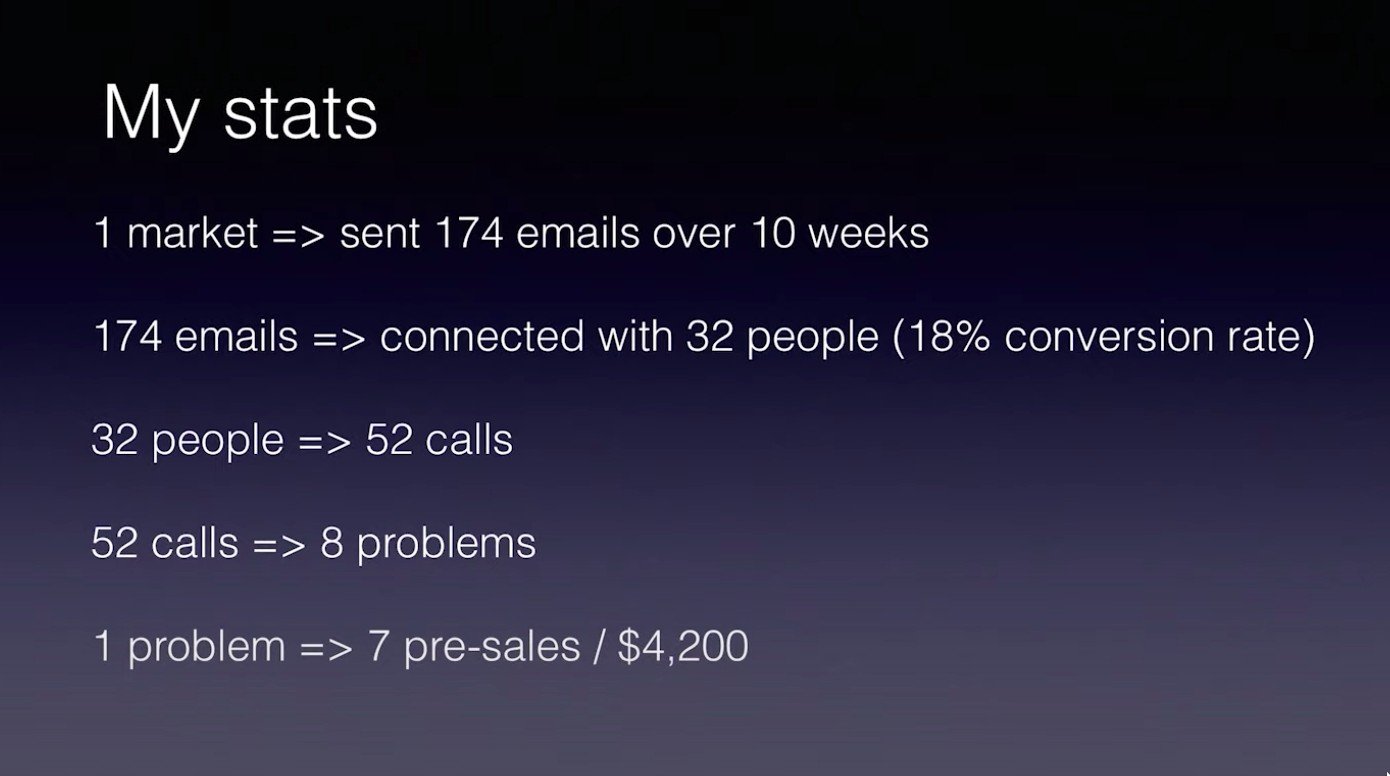
Pavel’s call stats and pre-sales
Most SaaS products can go the presale route. However, if yours can’t, the next best thing to do is to collect email addresses so you can bring potential customers along with you on your launch journey.
Part 3: Market Evaluation
In addition to validating your SaaS idea for product/market fit and potential profitability, you also want to evaluate it for founder/product fit.
You could have the best idea in the world. However, if the idea isn’t tied to your strengths as a founder, the odds of success are low.
You also want to be in an industry and around customers that interest you. If the industry is mind-numbingly boring to you, or you dread the idea of chatting with customers, you’ll be at a major disadvantage when, inevitably, the business hits a rough point.
In addition to founder/product fit, you also need to be able to run this new business in a sustainable and profitable way. This starts by evaluating the total addressable market (TAM).
The best markets for new SaaS founders often have the following characteristics:
Niche market
At least 2,000 potential customers
Affinity
The customers are reachable (i.e. you can find who they are: emails, phone numbers, etc)
The sales cycle tends to be shorter.
If you don't evaluate the market you’re in, you may run into some or all of these problems:
You can have an amazing product that’s well-validated, but if the majority of your prospective customers are locked into multi-year enterprise sales contracts, you’re going to run into issues.
There are only ~100 potential customers in your market. The market might be too small to build a viable business.
Your ideal customers are hard to reach (no way to get their email addresses!), and don't seek out solutions to the problem you solve through search. This will rule out many digital marketing strategies, like email marketing or content marketing.
You also need to evaluate the business from a financial perspective. At the simplest level, this is two questions:
Am I bringing in more than I’m spending?
Is this enough money?
There are other factors you may want to consider as well, like:
Type of product: Is it a vitamin or painkiller product? How much urgency do customers have?
Pricing potential
Customer acquisition cost
Cost of value delivery / servicing customers
Uniqueness of the product / offer
Speed to market
Upfront investment
Upsell potential
Evergreen product potential
There’s no such thing as the perfect SaaS idea. Instead of looking for a holy grail, focus on finding and solving a problem that a lot of potential customers care about.
Spend the time upfront validating the idea. Then, make sure the product you’re building is in a sizable market, can be run profitably, and aligns with your strengths as a founder.
Want to get even more actionable strategies and tactics for starting and launching your SaaS? Check out our curated playlist on YouTube.